The trading floor,
quietly rebuilt as one local app.
Trade. Brokerage. Introductions. Execution. Vessels. Commissions. KYC. All connected, all local, all owned by you.
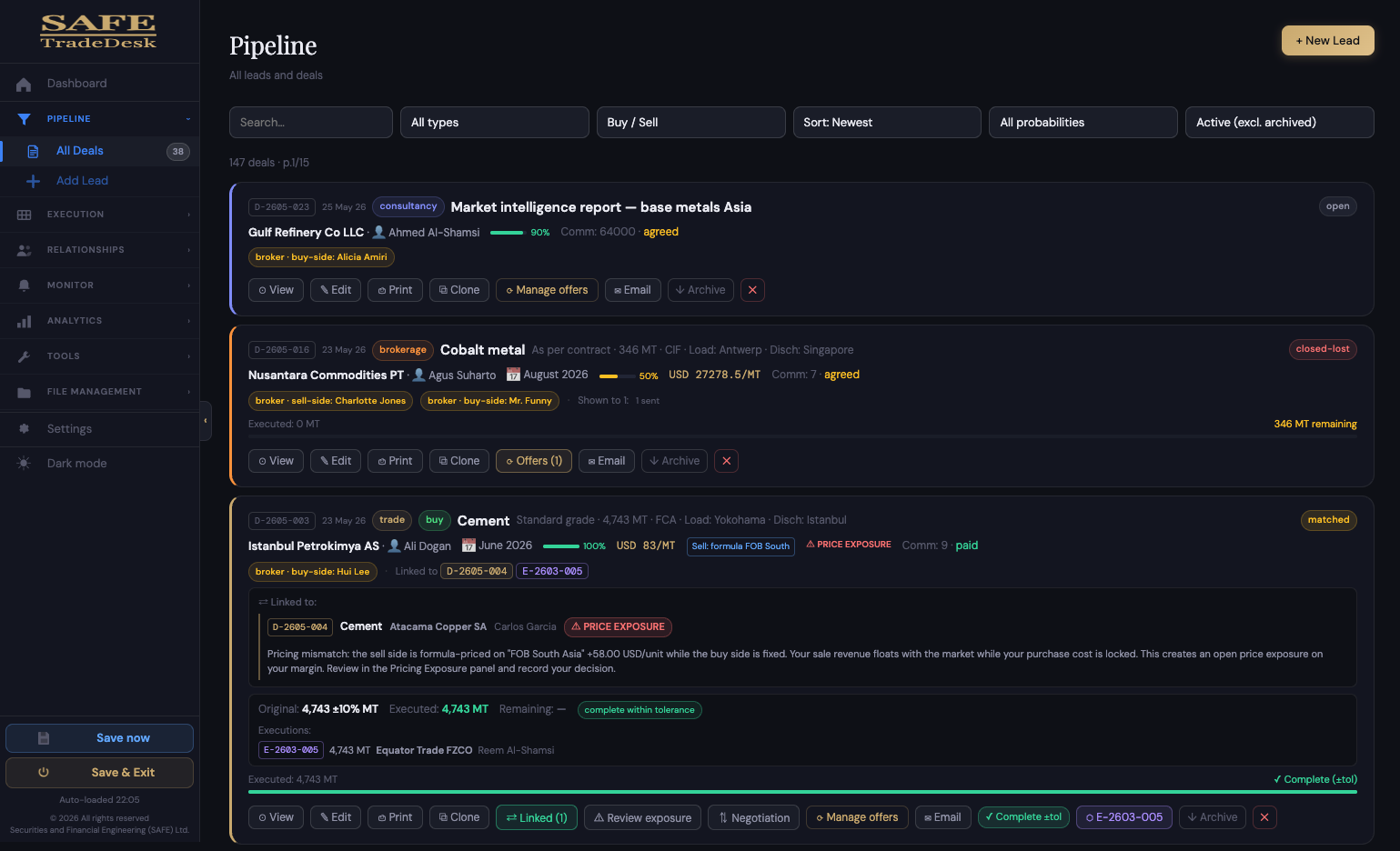
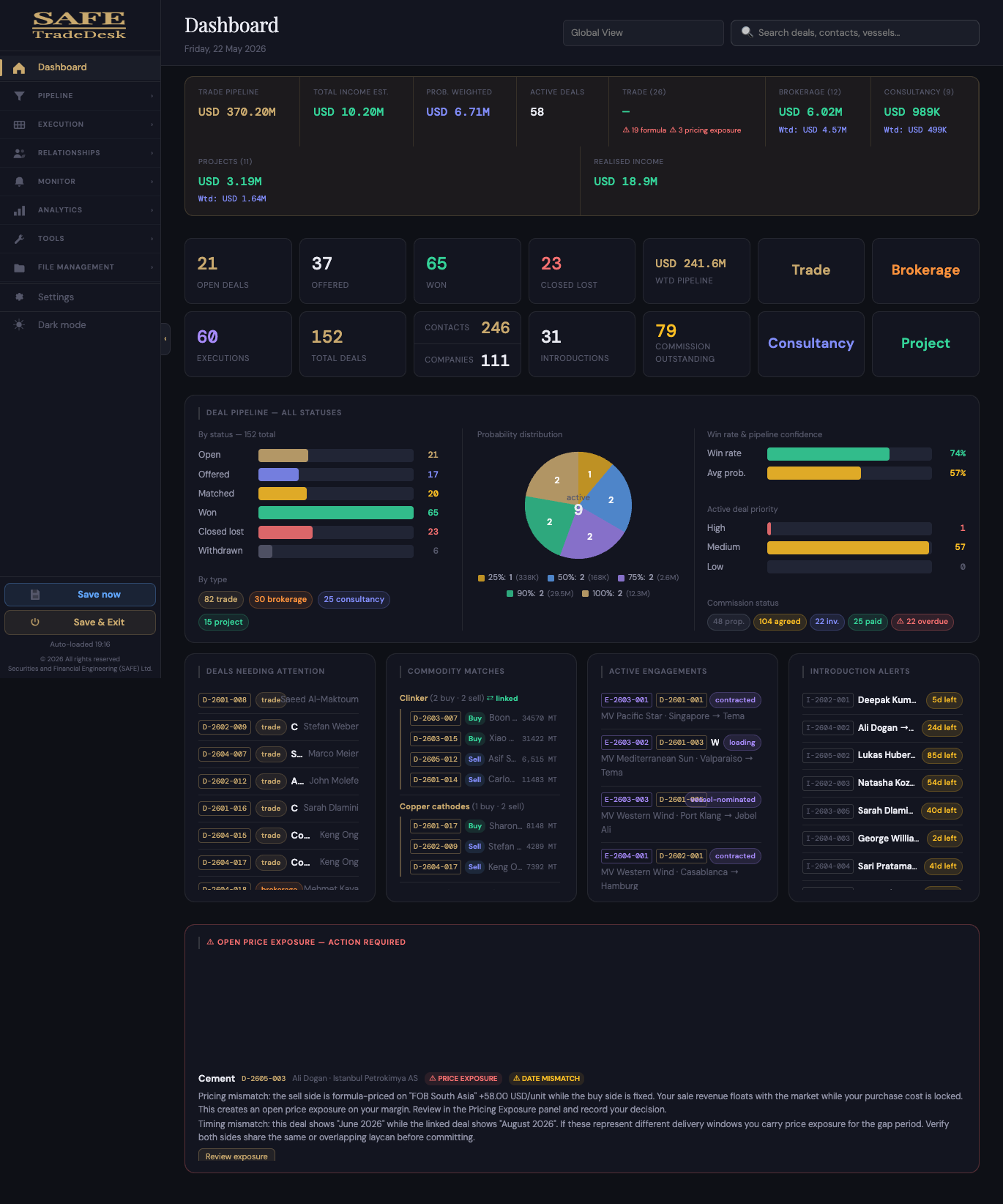
Built for the desk that is too complex for spreadsheets and too personal for enterprise software.
Small to mid-size commodity brokerages and trading operations need discipline without a heavy stack. TradeDesk keeps the working record close to the trader — local, searchable, printable, and structured around the actual commercial workflow of physical commodity trade.
A desk of one, or a desk of twelve.
SAFE TradeDesk fits the operator who is simultaneously a counterparty in one deal, a broker on another, and an advisor on a third — and refuses to live inside seventeen tabs.
Small daily disasters that cost real money.
Spreadsheets lose context.
A deal lives across five tabs — enquiry, pricing, KYC, vessel, commission. When it partially executes, every tab drifts out of sync.
Enterprise CRM doesn't speak commodity.
Generic pipelines don't model BL tolerance, partial allocations, vessel nominations or commission status.
Roles overlap, tools don't.
The same firm acts as broker, principal, agent, advisor. Most systems force one identity.
Introductions are treated as folklore.
Who introduced whom, under what protection, expiring when — lives in a senior person's head.
Cloud SaaS isn't always wanted.
Sensitive counterparty and pricing data shouldn't have to leave the laptop to be useful — many desks prefer a portable file.
Same realities, three answers.
| Capability | Spreadsheets & email | Enterprise CRM | SAFE TradeDesk |
|---|---|---|---|
| Partial cargo allocations & remaining balance | Manual, fragile | Not modelled | ✓ Auto from linked execs |
| Broker, principal & consultant in one platform | Separate sheets | One identity | ✓ Four deal types |
| Multi-counterparty matching (1 sell → many buys) | Visual headache | No support | ✓ Grouped panel |
| Vessel registry with IMO-based history | Free-text | Not aware | ✓ Voyage log + tracker |
| Introduction protection & renewal tracking | Reminders | Custom object | ✓ Native registry |
| Pricing exposure mismatch alerts | Read manually | Not modelled | ✓ Fixed / formula / QP |
| Commission lifecycle (proposed → paid) | Separate sheet | Custom-built | ✓ Tied to executions |
| Daily action list from real records | In your head | Reports | ✓ Today + Daily Brief |
| Operates fully offline | ✓ | Cloud-dependent | ✓ Single HTML + JSON |
| Your data, no vendor lock-in | ✓ | Vendor servers | ✓ Portable JSON |
| Total cost of ownership · 3 yrs | Free · hidden time | USD 12k–60k+ / seat | ✓ One-time license |
A full desk, organised by how a desk thinks.
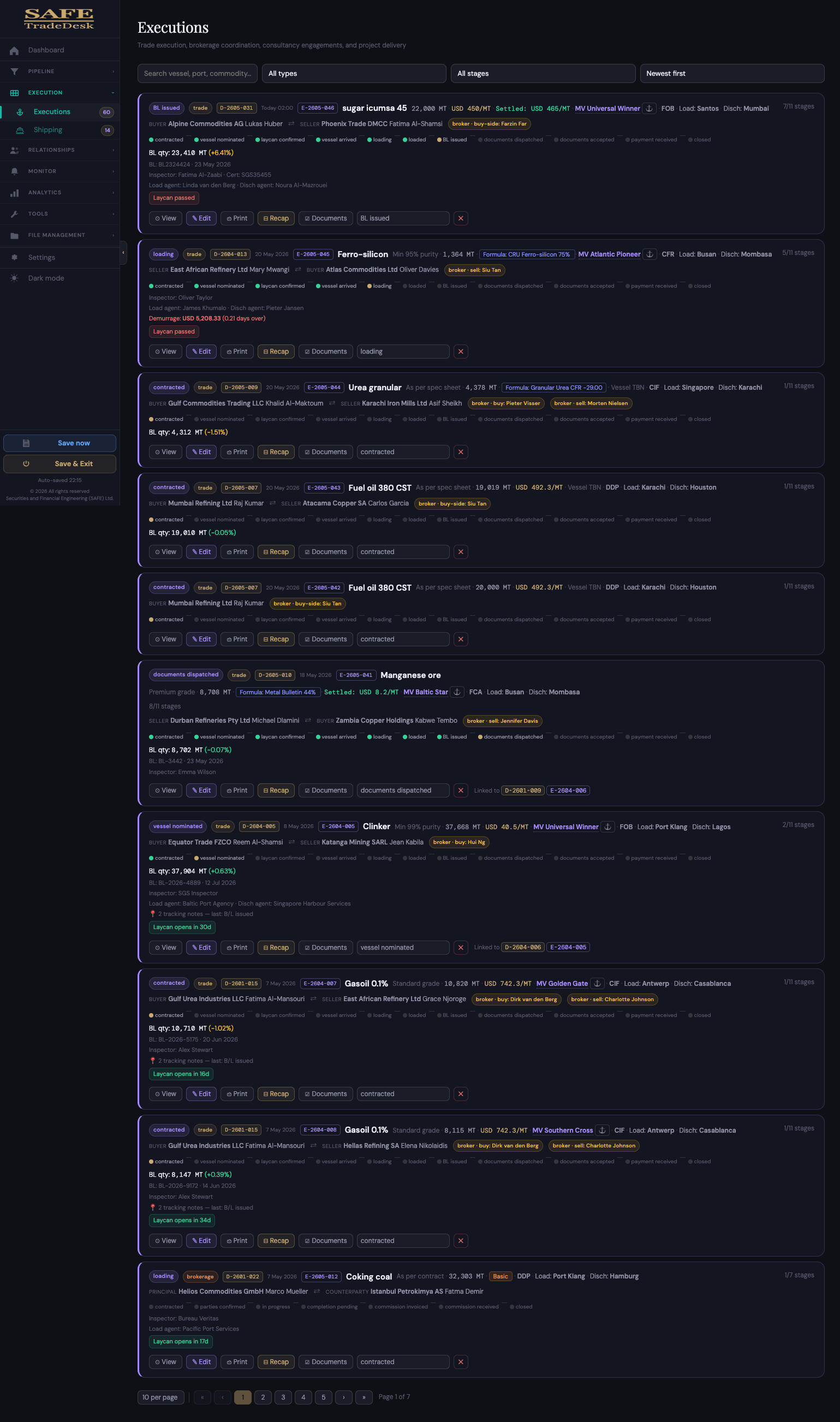
The same data, the theme that suits the room.
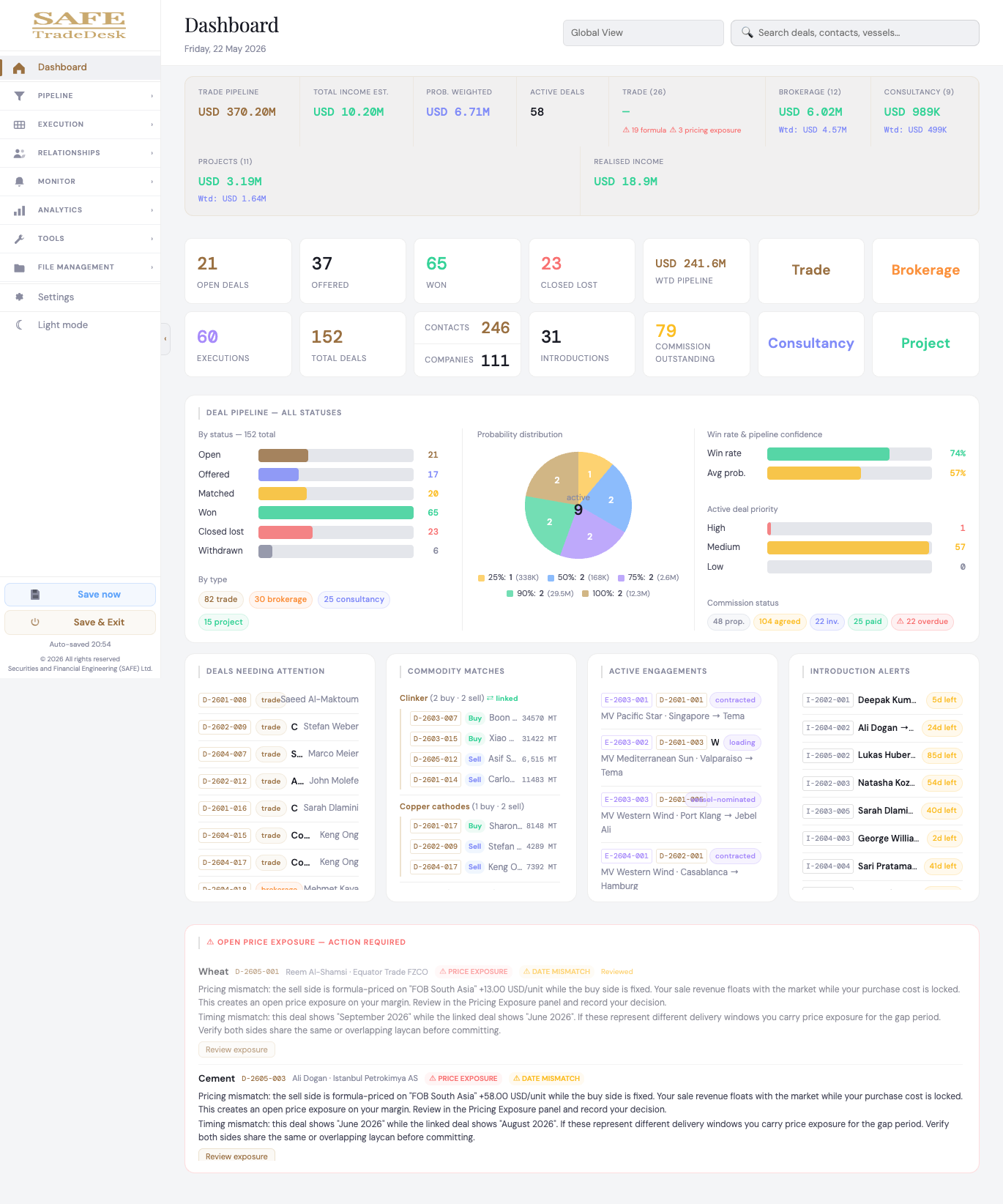
The whole desk on one screen, at 1080p.
Every tile is interactive. Click any number to drill in. Four operational panels load in parallel — 152 deals don't slow you down.
Four record types. One financial language.
Each commercial logic is kept distinct — but reporting, CRM context and income analysis are consolidated under one ledger.
Principal trading
Buy or sell physical cargo as principal. Pricing, margin, linked legs, partial allocations and full execution stages.
Intermediary mandates
Side-aware records — mandate side, Party B, commission per unit, flat or %. Optional full execution.
Advisory work
Service scope, fee structure, deadlines, retainers. No cargo fields — clean engagement tracking.
Project delivery
Project mandates with scope, % completion, milestone fees and delivery reporting.
Every lead remembers what it is, who, when, why.
- ▦Buy / sell / linkedDirection and counter-leg, tracked from day one.
- %Probability + priorityNot just stages — explicit trader conviction.
- @Snooze & archiveStop a deal cluttering Today without losing the record.
- ✎AI parsePaste an enquiry, get a structured lead — or fill by hand.
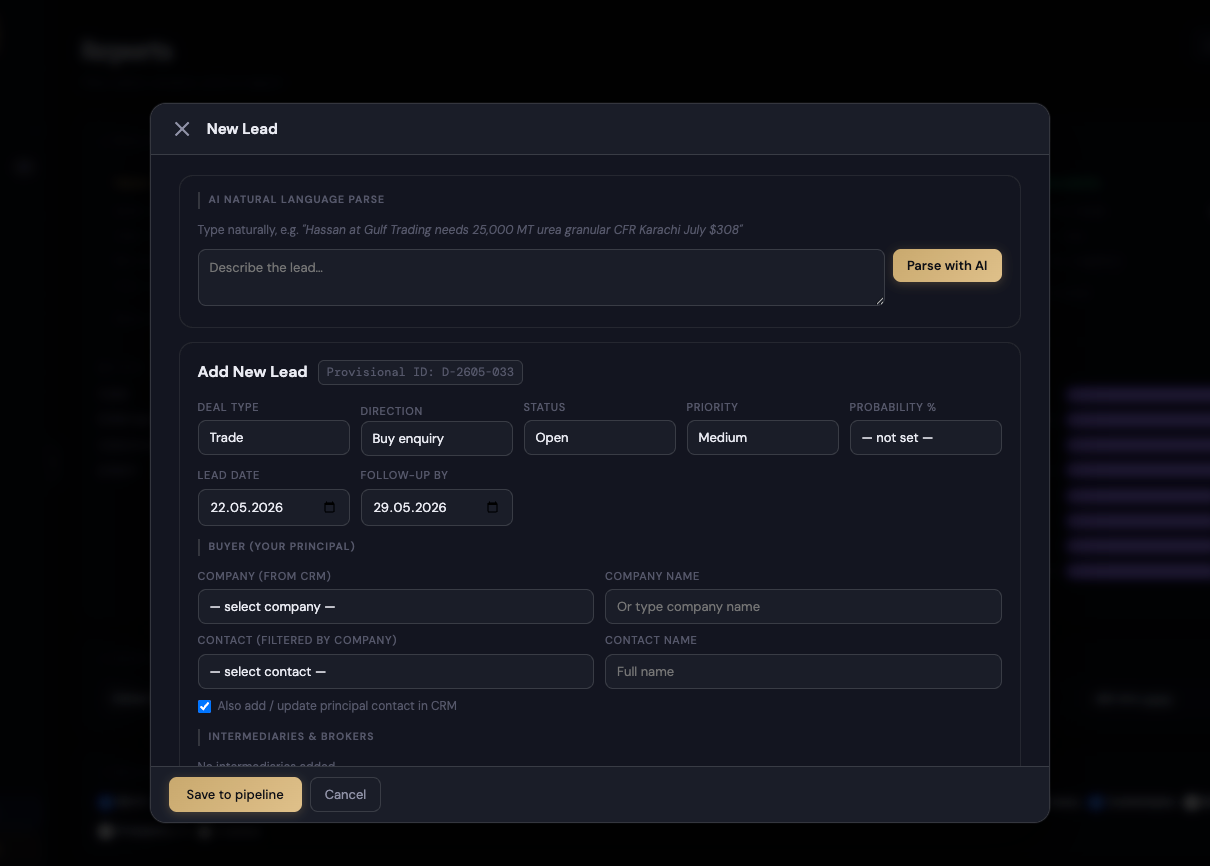
Type the enquiry. Get the lead.
Lead entry is where most CRMs lose the day. TradeDesk inverts it — paste a counterparty message in any shape, the parser fills the structured fields, then you correct, not author.
- 01Free-text or structuredNo enforced template.
- 02Linked counterpart auto-createdThe matching opposite leg, ready to fill.
- 03Defaults follow your workflowFollow-up dates, principal role, probability.
Operational records that remember their commercial source.
Source-deal allocation, parties, vessel snapshot, laycan, BL, inspection, port agents, documents, payment, commission — and the link back to the pipeline that produced it.
Contract qty · BL qty · tolerance — three distinct ideas.
Physical cargoes rarely lift the exact nominal number. TradeDesk separates the contract commitment, the actual bill of lading quantity, the commissionable quantity and the remaining pipeline balance — without ever confusing one for another.
Saved on the deal record, used for allocation.
Deal-level tolerance treats small variances as complete.
Actual lifted quantity from the bill of lading.
Optional override, else commission is on BL qty.
Every vessel — a first-class record. Every voyage — logged.
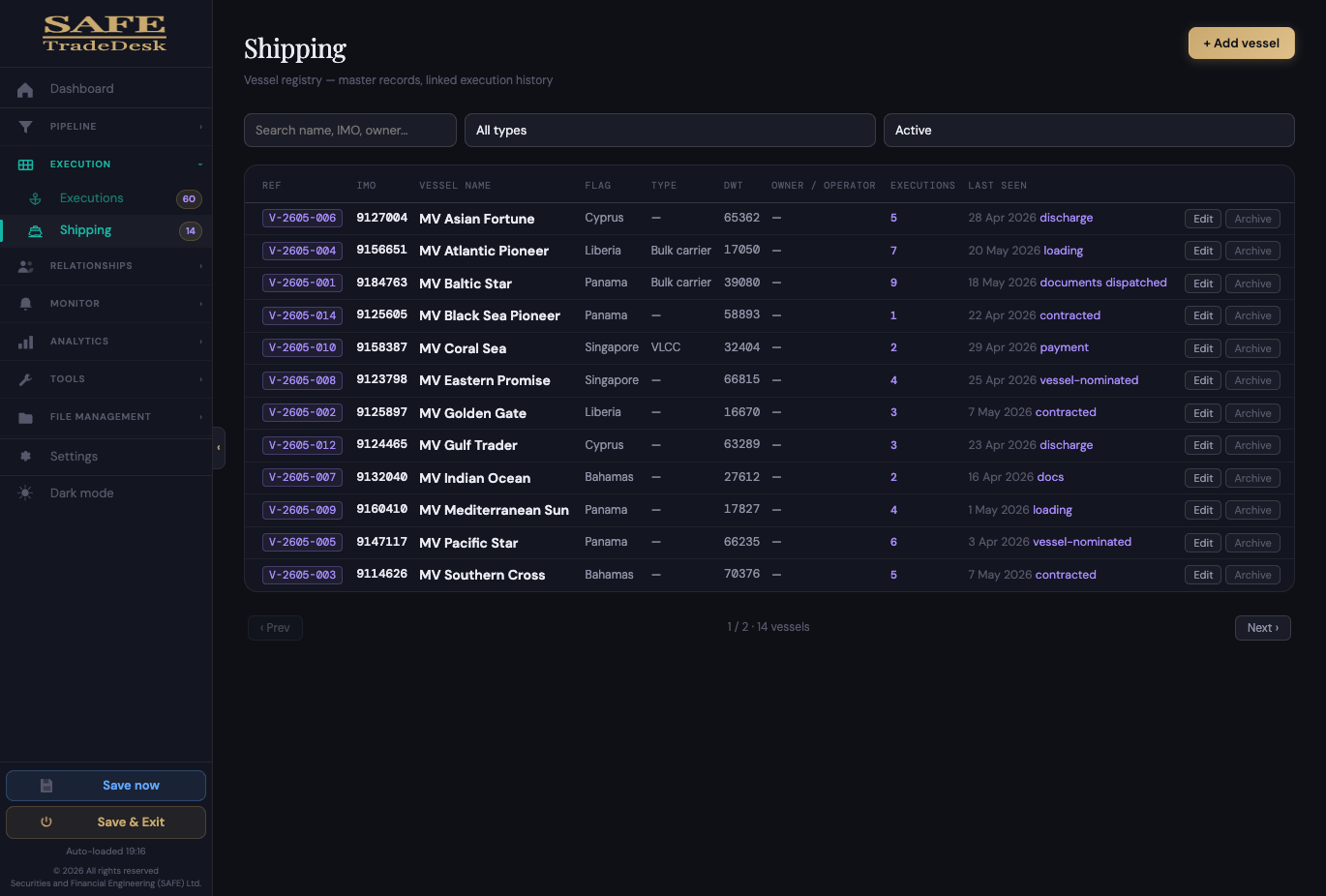
Vessel registry · 14 active vessels
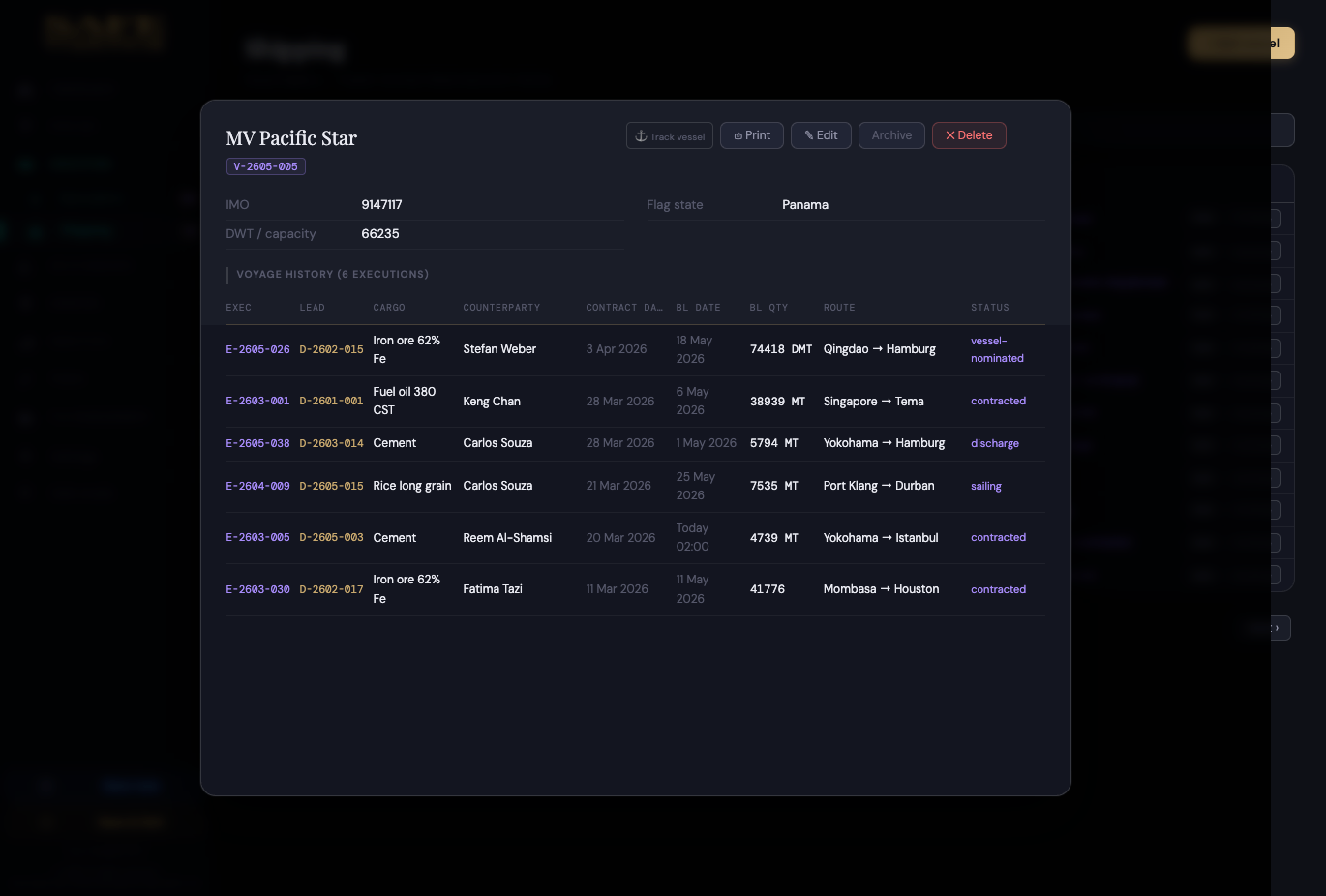
- ⌖MarineTraffic & VesselFinderOne click from any execution opens the chosen tracker on the right vessel.
- ⚐IMO-first lookup · TBN guardIMO prefills name, flag, type, capacity. TBN / blank never create junk records.
- ⏱Voyage snapshot preservedHistorical vessel data stays on the execution even if the vessel is renamed.
"The software that runs a small physical-commodity desk should be as portable as the desk itself. One file, on one laptop, that you can take to a port, an arbitration room, or a Sunday morning." — SAFE design philosophy
Local by default.
One HTML application, one JSON file. No cloud subscription, no per-seat invoice, no vendor lock-in.
Built for many hats.
The user may be broker, principal, agent and advisor — sometimes in the same week. The system never forces a single identity.
Operational, not decorative.
Every screen prints to a useful document. Daily brief, recap, KYC summary, introduction report — ready for an inbox.
CRM connected to deal work, not isolated from it.
Contacts and companies carry KYC, timelines, role labels, linked deals, executions, introductions and printable activity reports — the same record acts as principal, broker and execution counterparty without breaking continuity.
- ⌘Tabbed contact workspaceDeals · executions · KYC · timeline · relationships.
- ✉Email · WhatsApp · LinkedInCommunication shortcuts directly from the contact card.
- ⚐KYC at a glance2/8, 8/8, complete — visible on every contact tile.
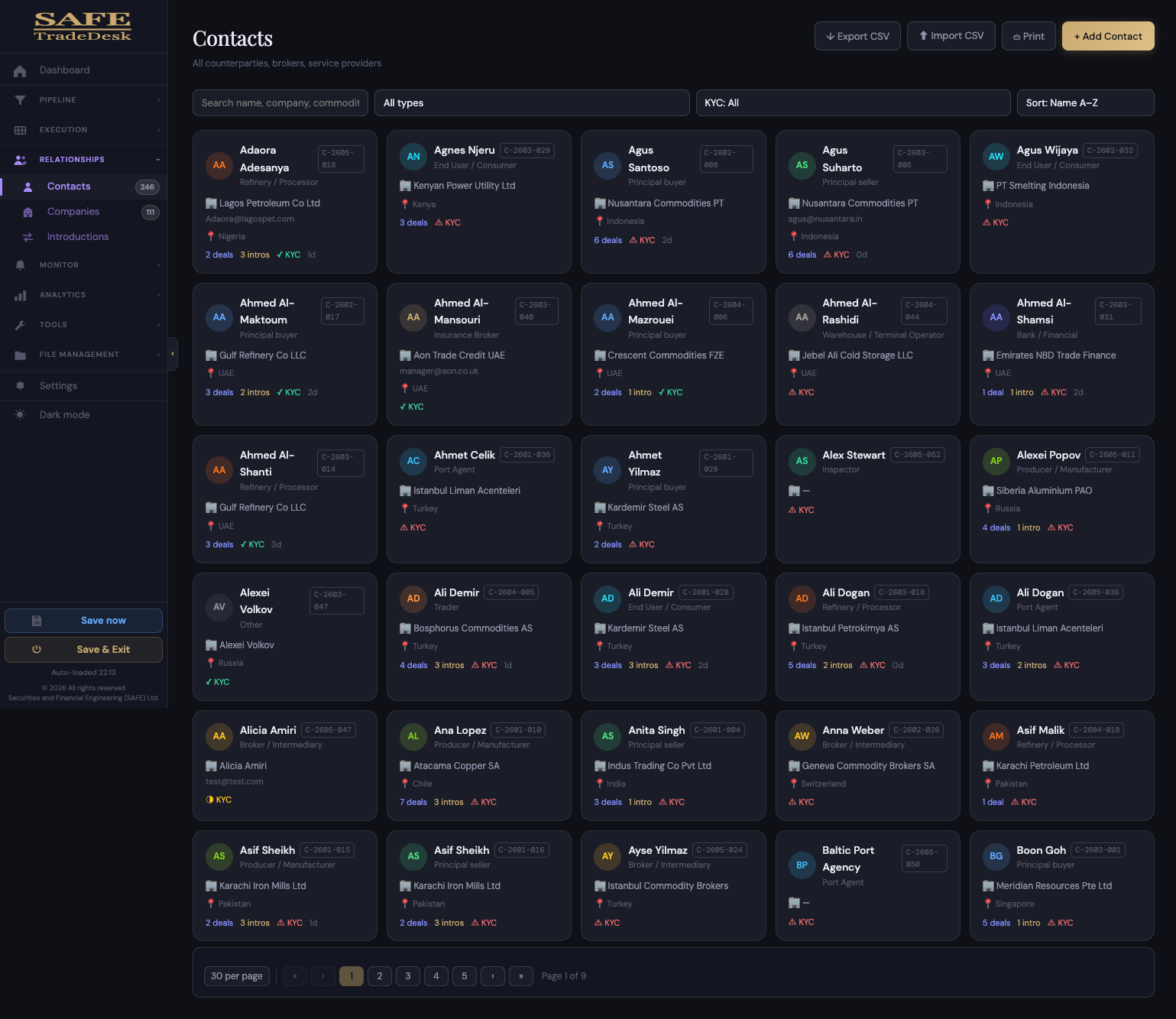
Company KYC, contact KYC — separately tracked, both auditable.
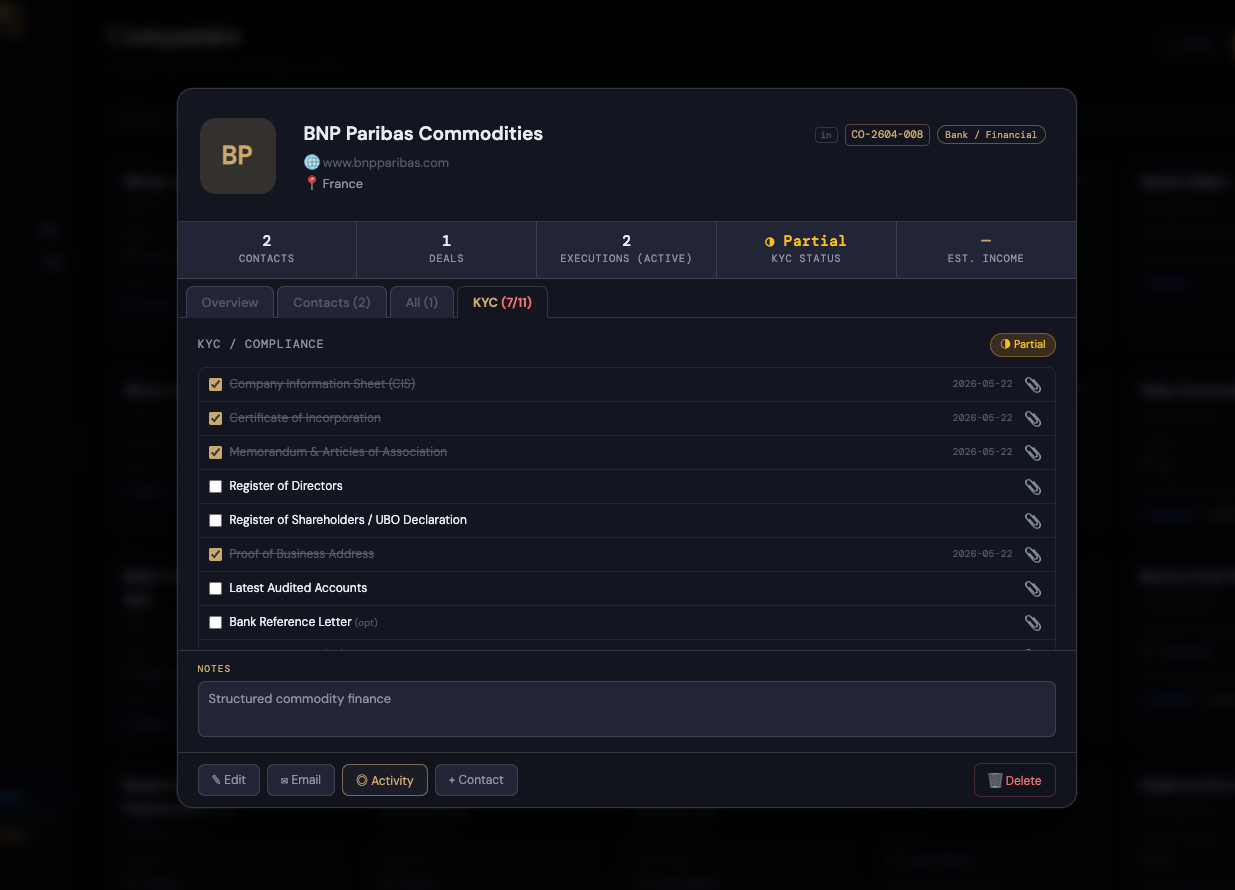
Companies, with KYC packs at the company level — separate from personal KYC, the way regulators actually treat them. Type, country, document count, deal count, linked contacts.
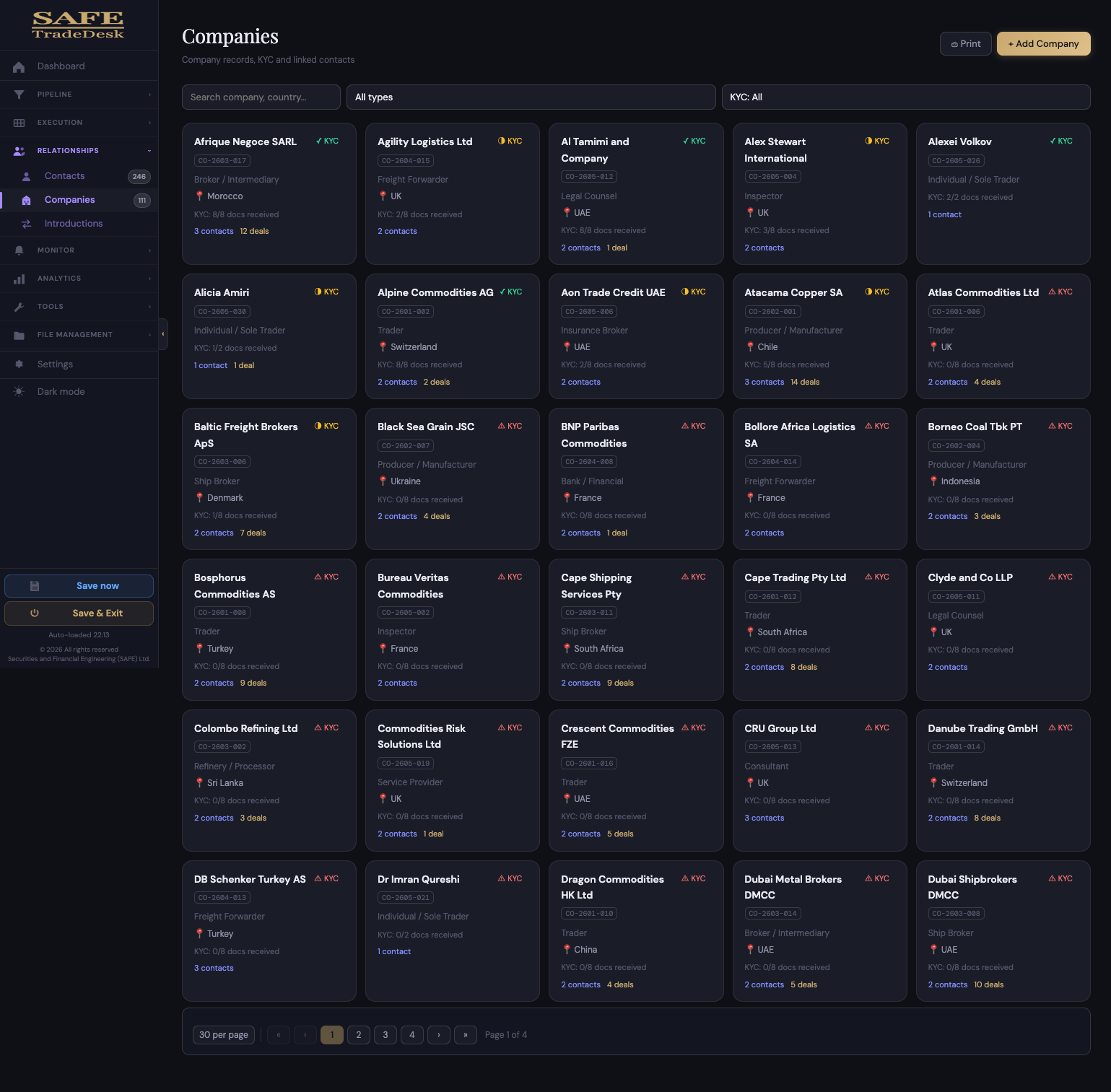
- ⎙Company-level KYCCIS, Certificate of Incorporation, M&A, UBO, Audited Accounts — tracked individually.
- ⊞Linked contacts & dealsThe company sees all its people and all its commercial activity.
Introductions are commercial assets. Treated as such.
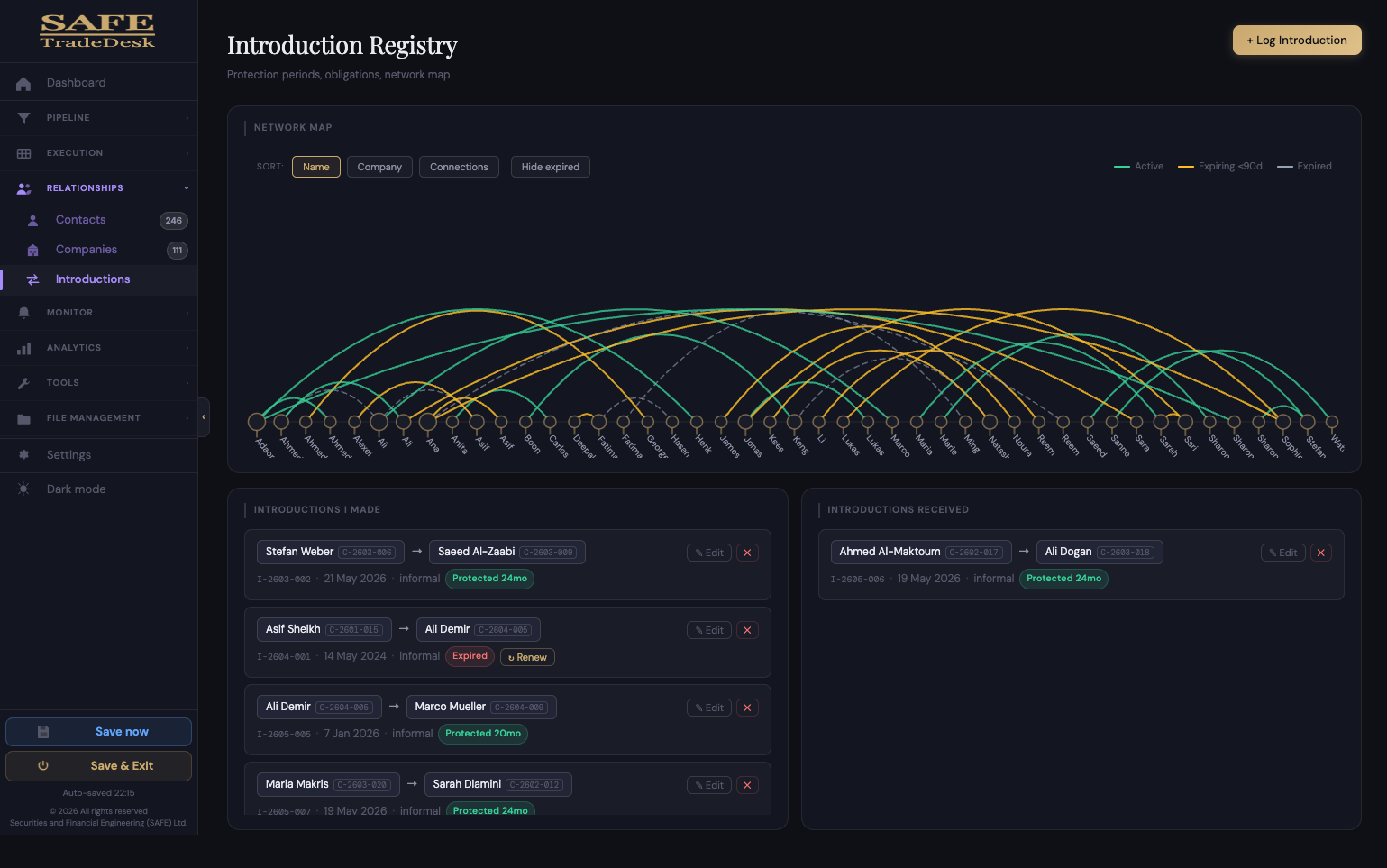
Who introduced whom, under what protection, expiring when, with what resulting deal value — the relationship graph is the small desk's most valuable IP, and it lives here.
- ⏳Protection timerActive · expiring ≤90d · expired, colour-coded with renewal workflows.
- ⌖Value attributionEach introduction reports deals won, pipeline volume, income attributed.
- ⚯Network mapArc visualisation of all introductions, with sorting and expired-only toggles.
- ⎙Print-ready reportSend "introductions and resulting income" to a partner in a single click.
Commission, pricing risk & the won-deals ledger.
Commission tracker
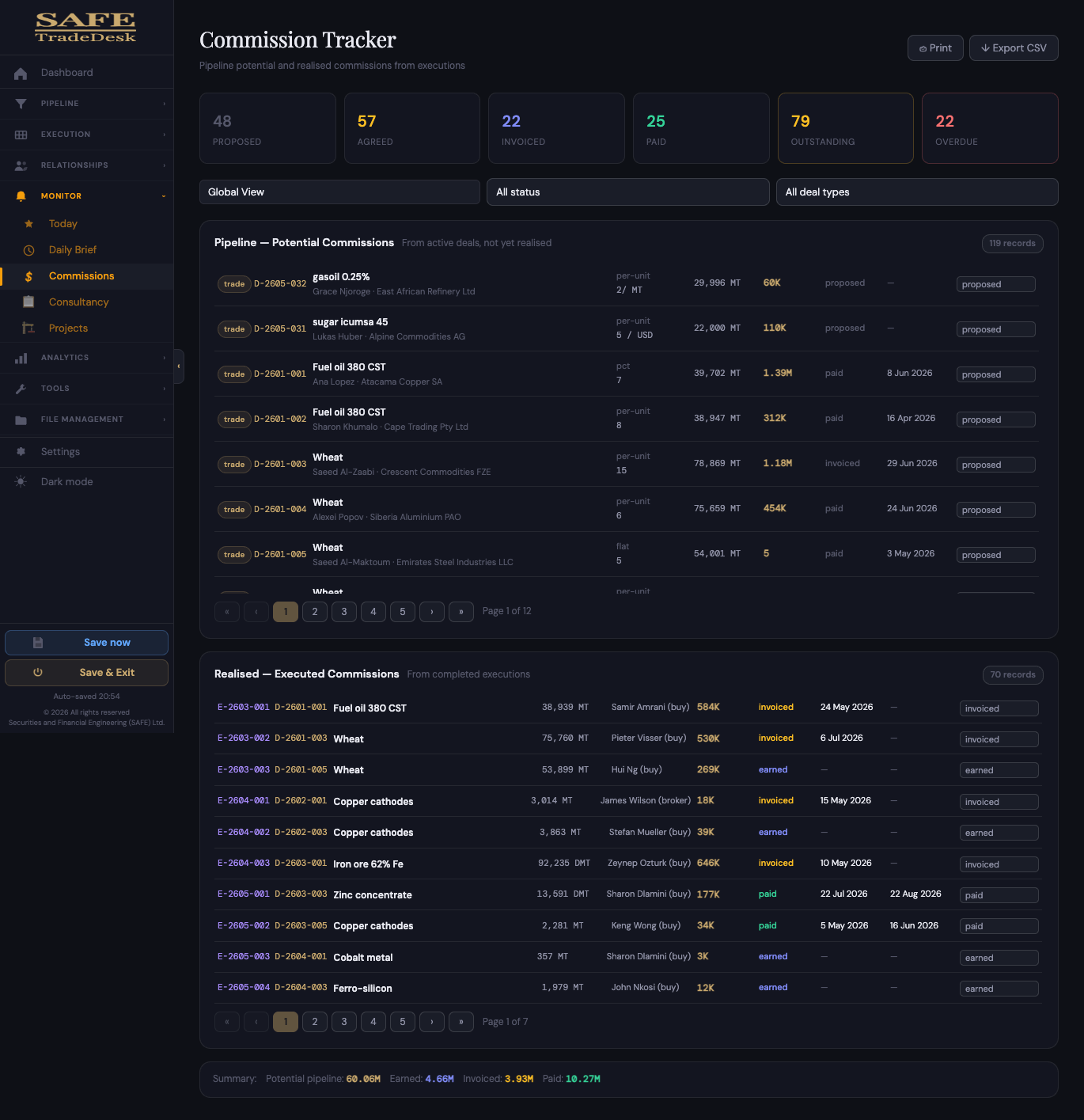
Every commission is born from a deal and tied to an execution. Status pills move with the lifecycle: proposed → agreed → invoiced → paid. Late ones turn amber, then red. Pipeline and realised sit side-by-side — never in two reports.
- ∑Per-unit · flat · %Commission can be a per-MT figure, a flat amount or a percentage.
- ⎙Printable & CSV-readySend to accounts, or import into a finance tool.
- ⌖Tied to executionsPipeline potential and realised commissions in one view.
Today. Everything that wants your attention right now.
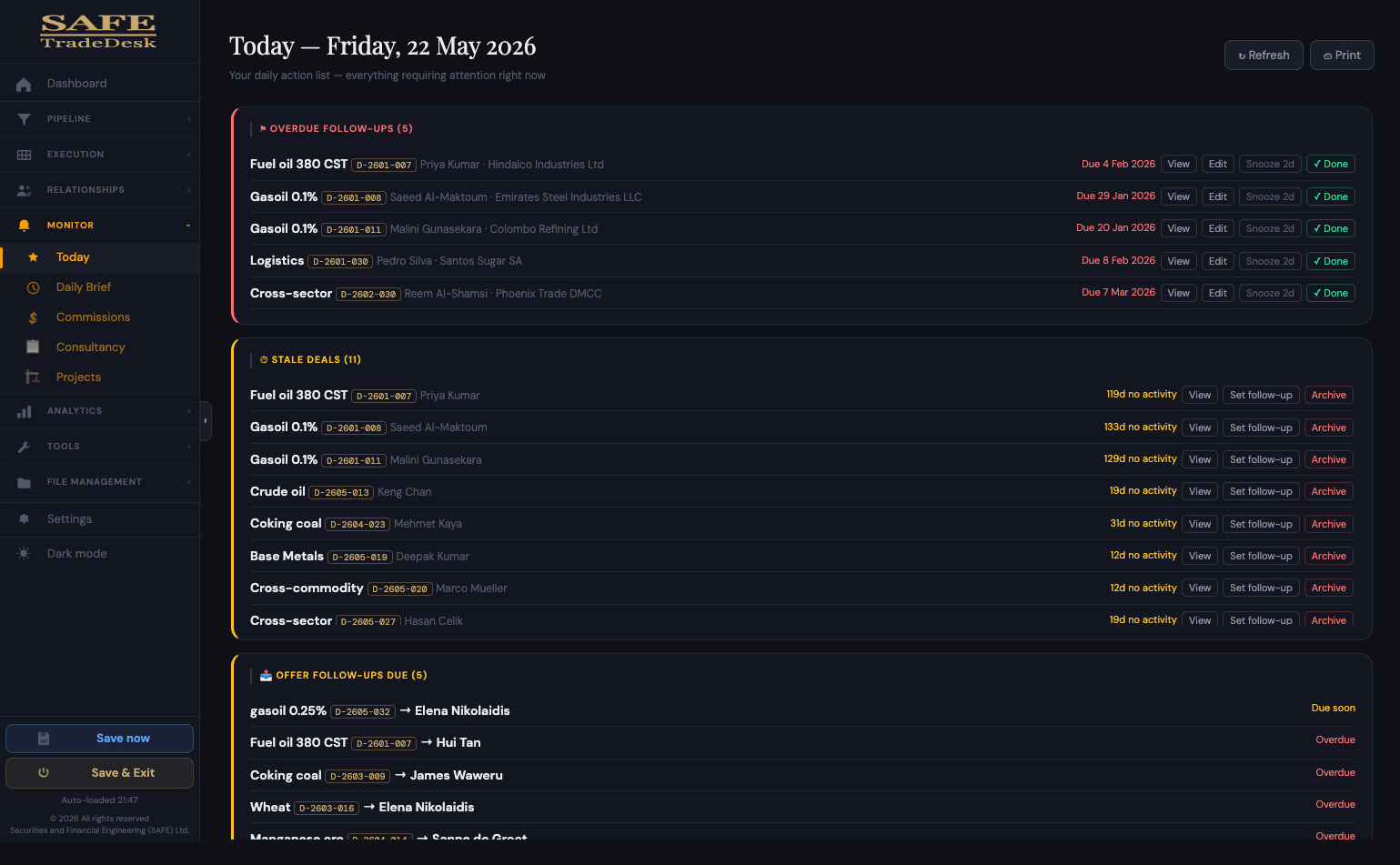
Today — generated from live data
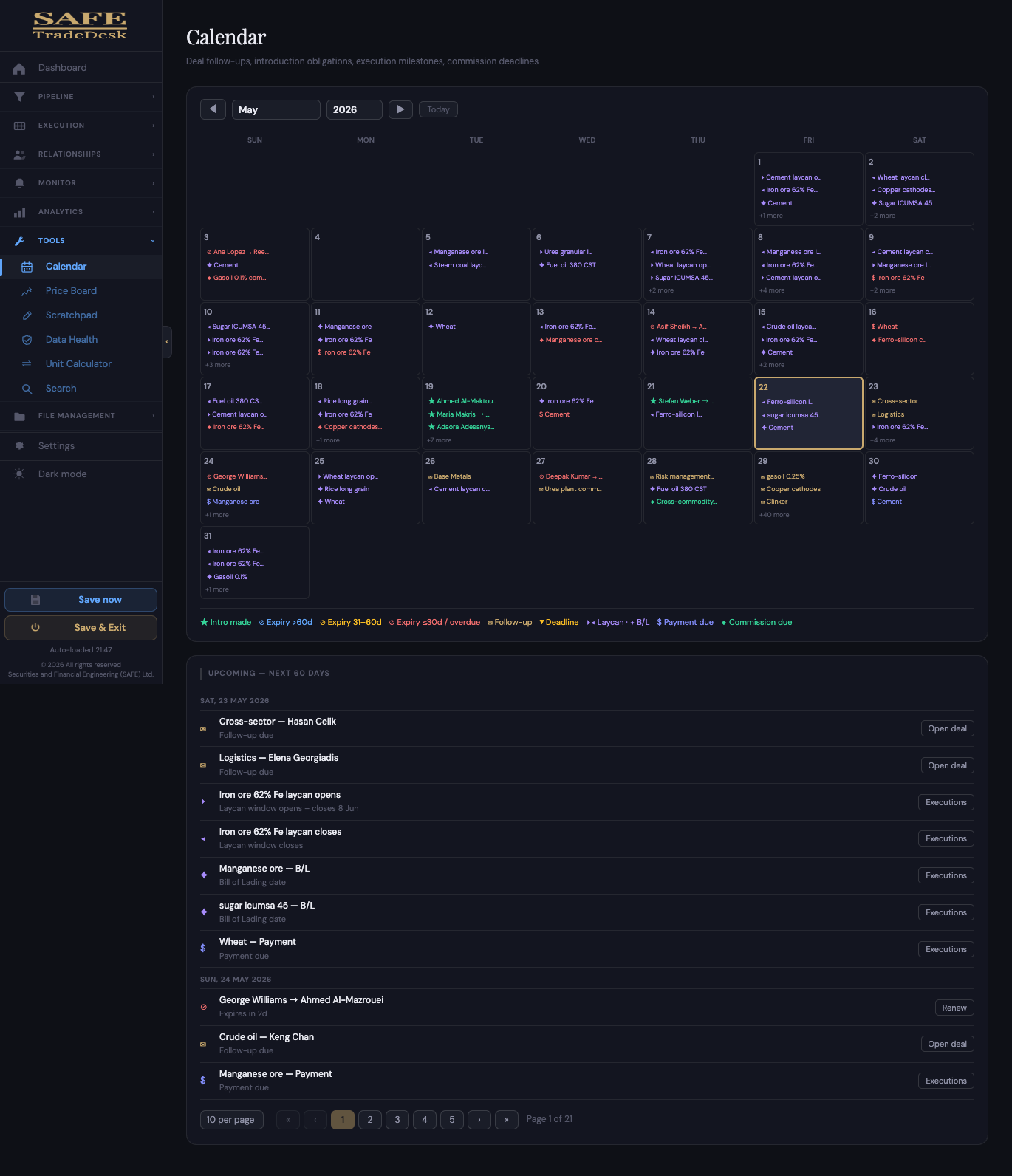
Calendar — follow-ups, laycan, B/L, payment, commission
An AI brief that reads the data you already have.
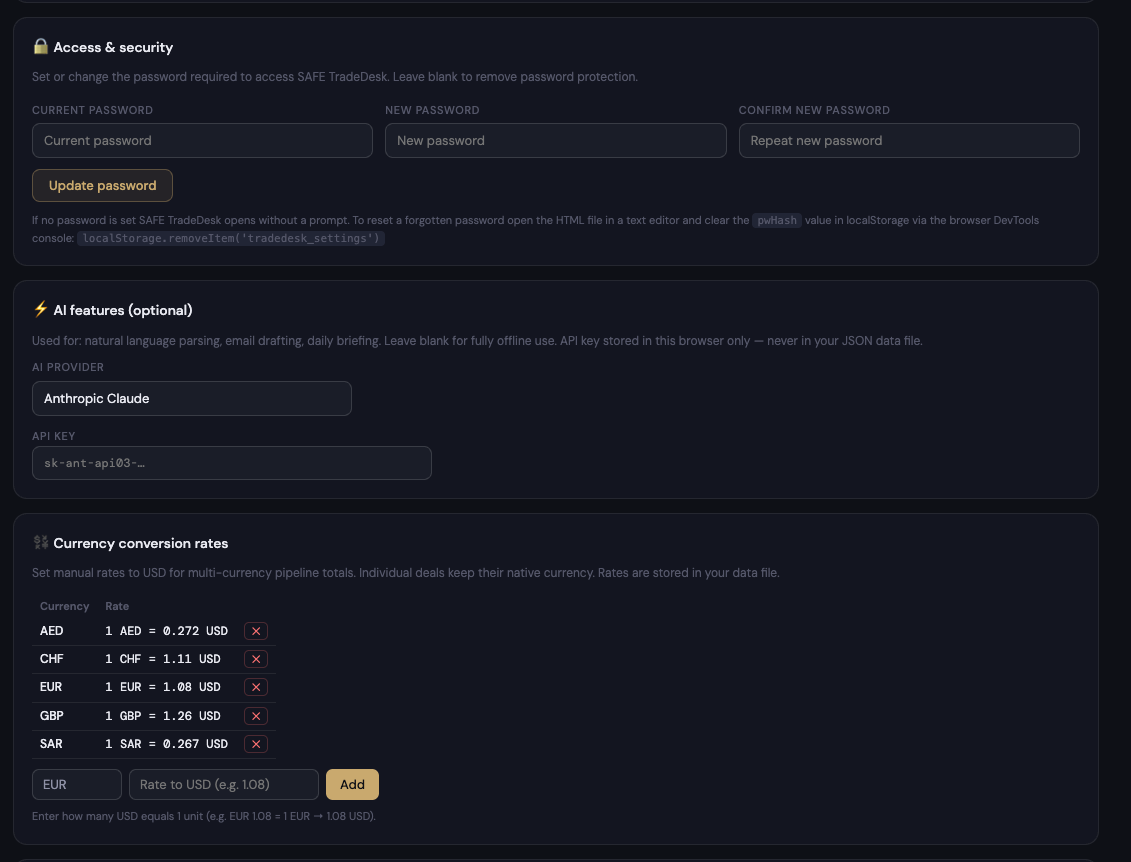
Bring your own API key. TradeDesk uses it sparingly — natural-language lead parsing, morning briefing, email drafting, counterparty briefings. Without a key, the same screens still produce mechanical briefs from your live records, and every other feature works offline.
- ✎Lead parsingFree-text enquiry → structured deal record.
- ☼Daily briefingA 60-second narrative summary of pipeline, KYC, exposure.
- ✉Email & counterparty draftingCompose with the deal's actual context.
API key stored in your browser only — never written into the JSON data file.
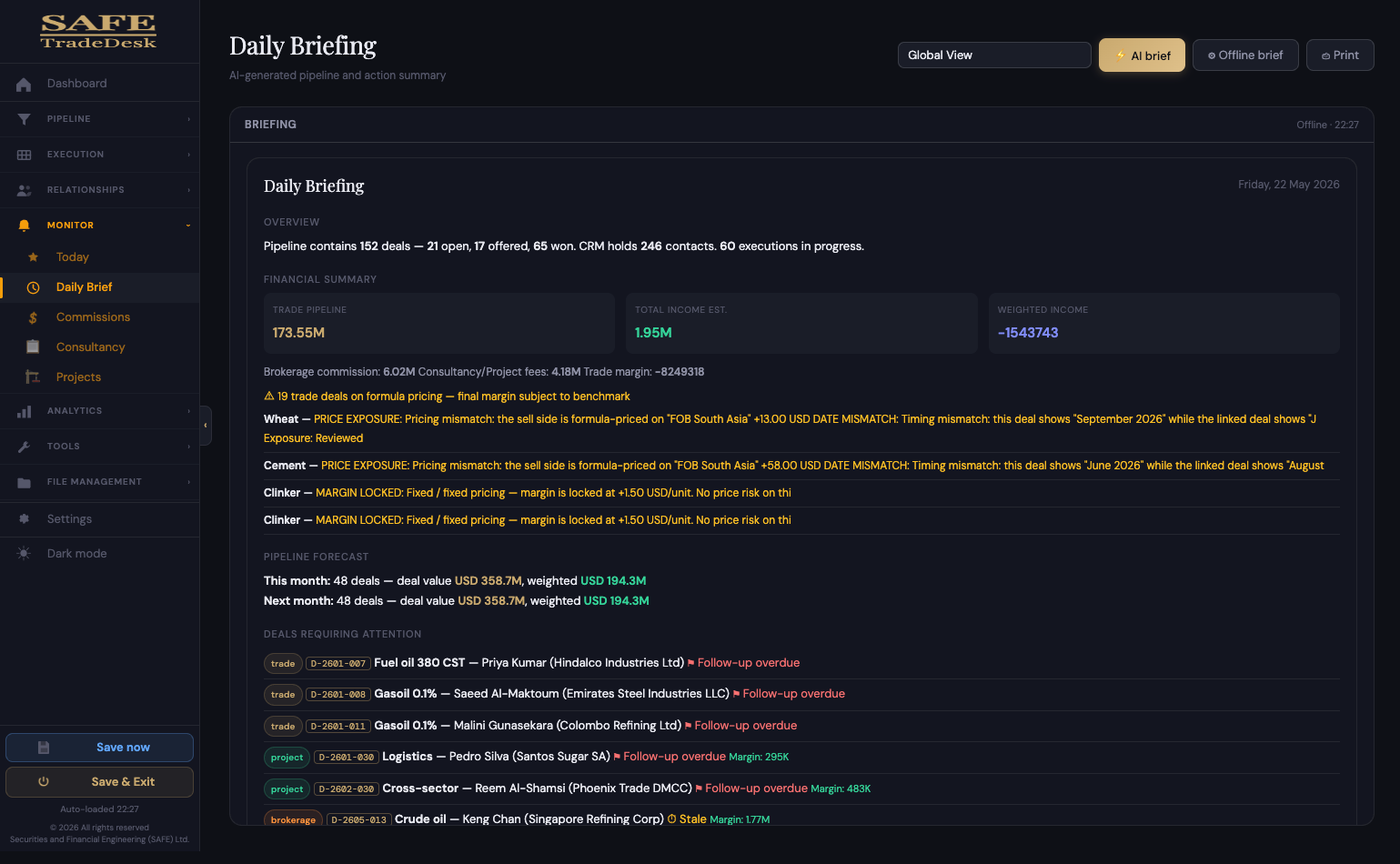
Reports that are operational, printable, role-aware.
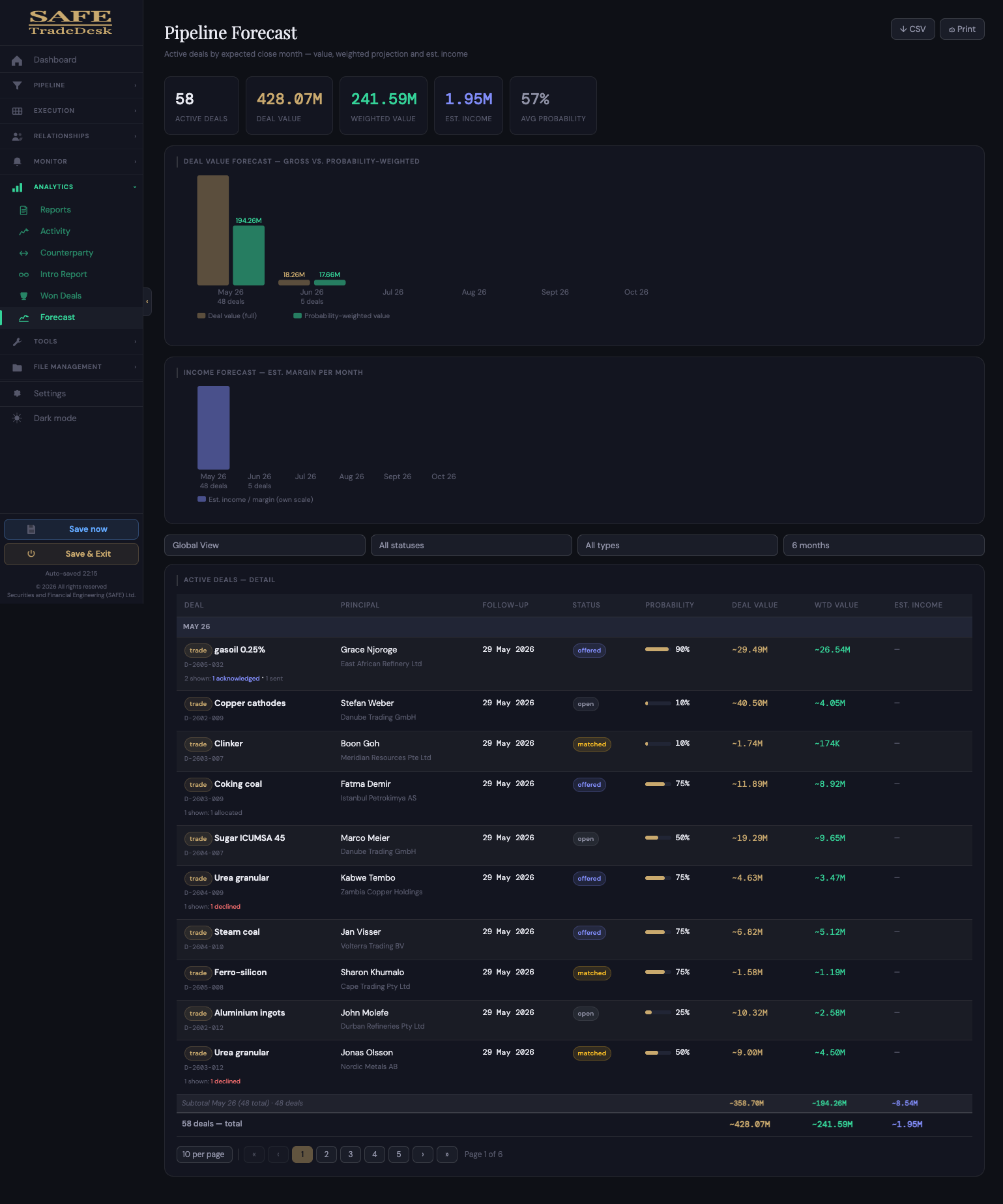
Pipeline forecast
By expected close month — value, probability-weighted projection, income.
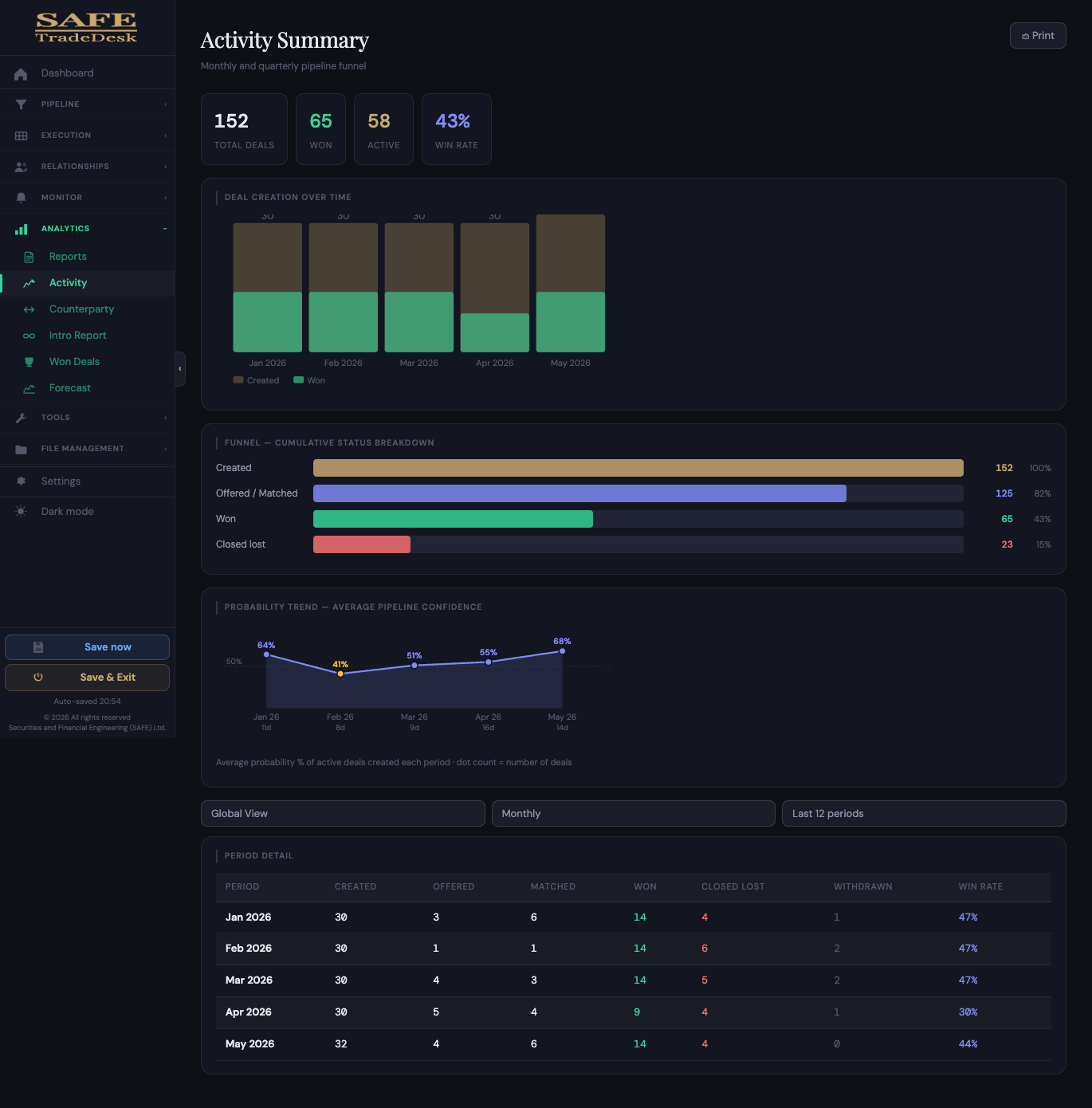
Activity summary
Funnel: created · offered · matched · won · lost. Win rate, probability trend.
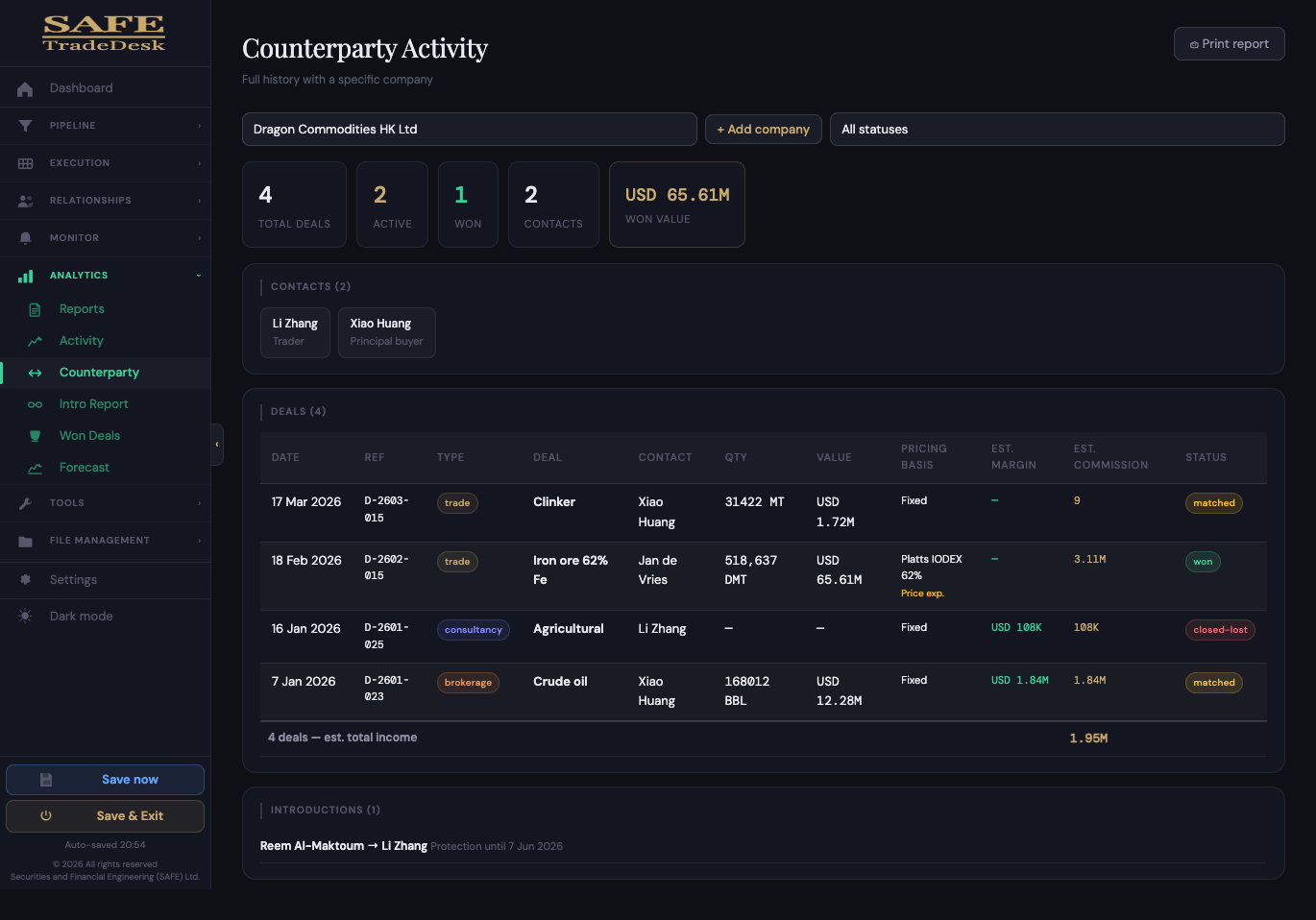
Counterparty deep-dive
A company's full history — across every role, with print-ready output.
Advisory work that shares the same operational rails.
A trade isn't always a cargo. Market entry, regulatory work, supply-chain advisory, due diligence — first-class deals with retainers, milestones and fees billed in the same commission tracker.
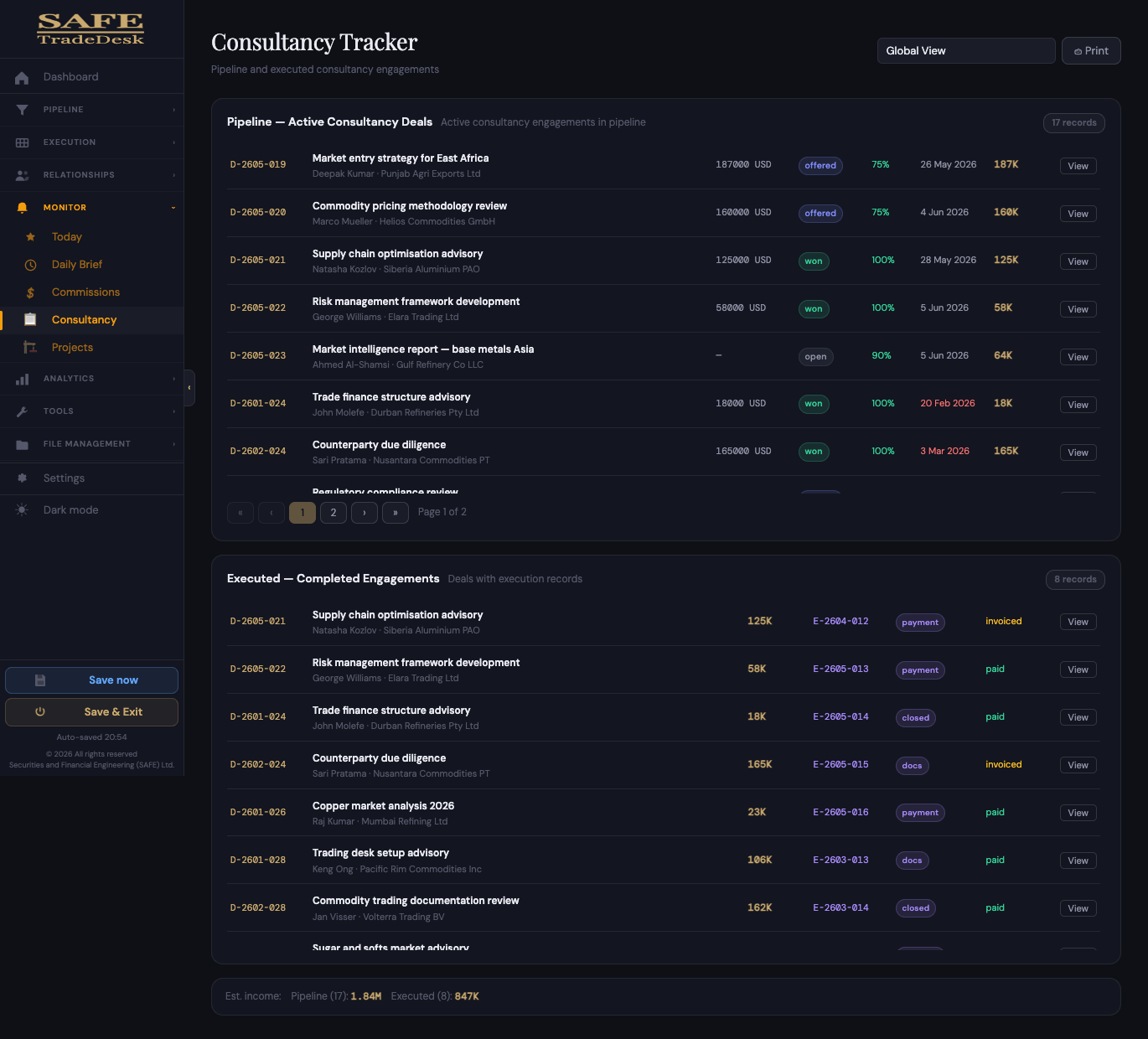
Consultancy tracker
Pipeline of advisory engagements with offered, won, paid status and per-deal probability.
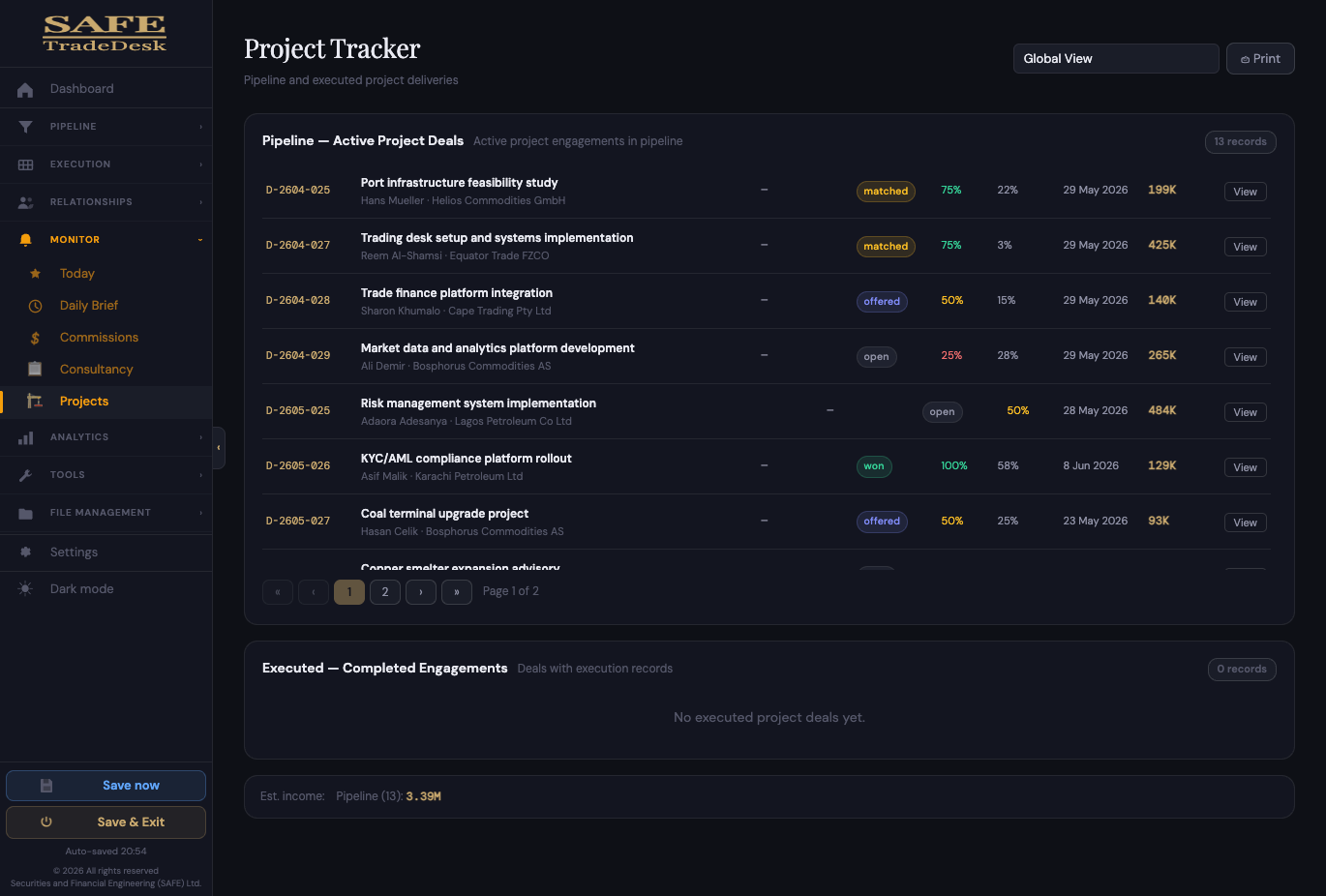
Project tracker
Larger delivery work — feasibility, integrations, rollouts — with % completion and milestone fees.
The quiet tools that hold a desk together.
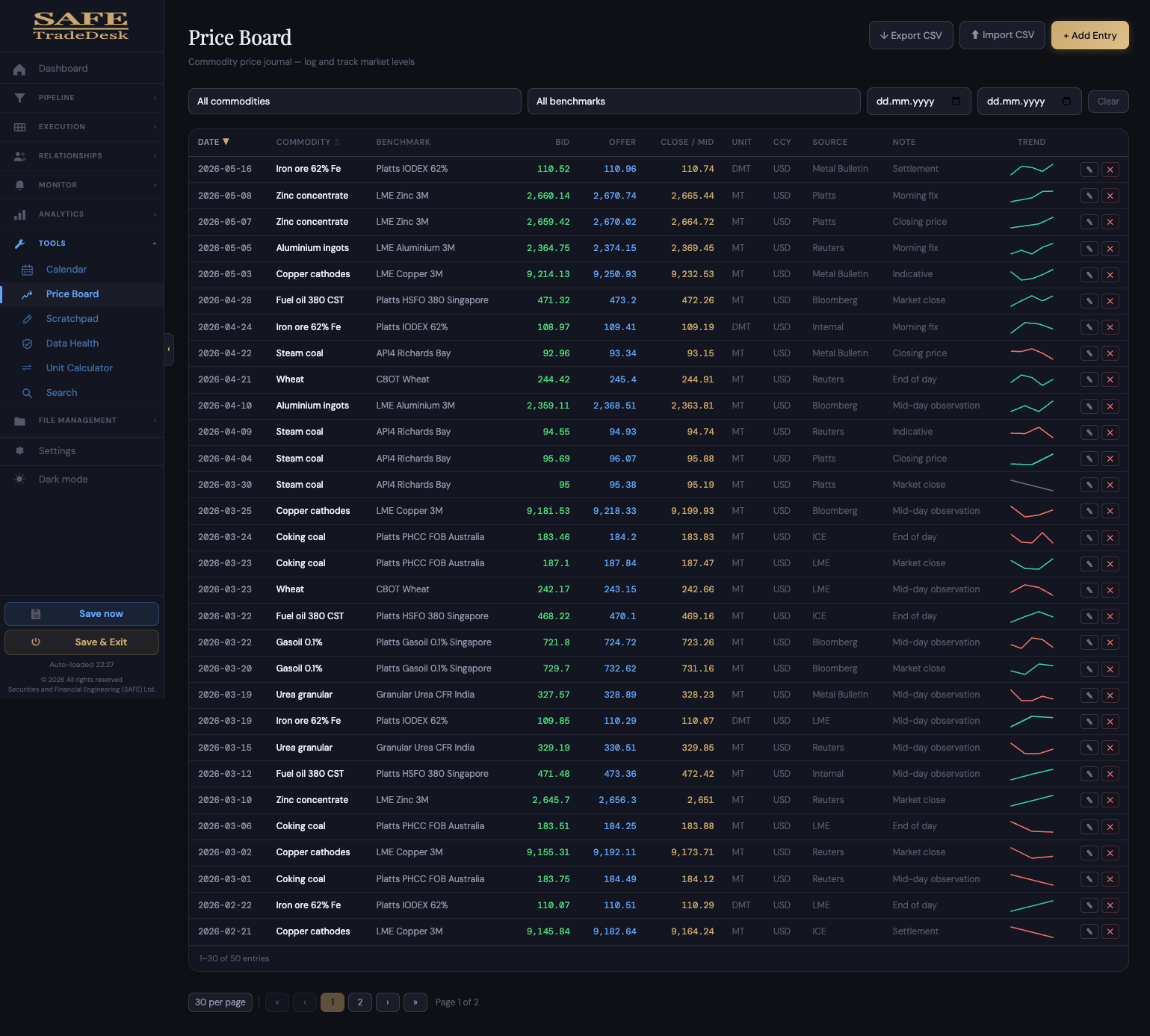
Price Board
Bids · offers · mids tagged by source (Platts, LME, Reuters). Sparkline per commodity. CSV in / out.
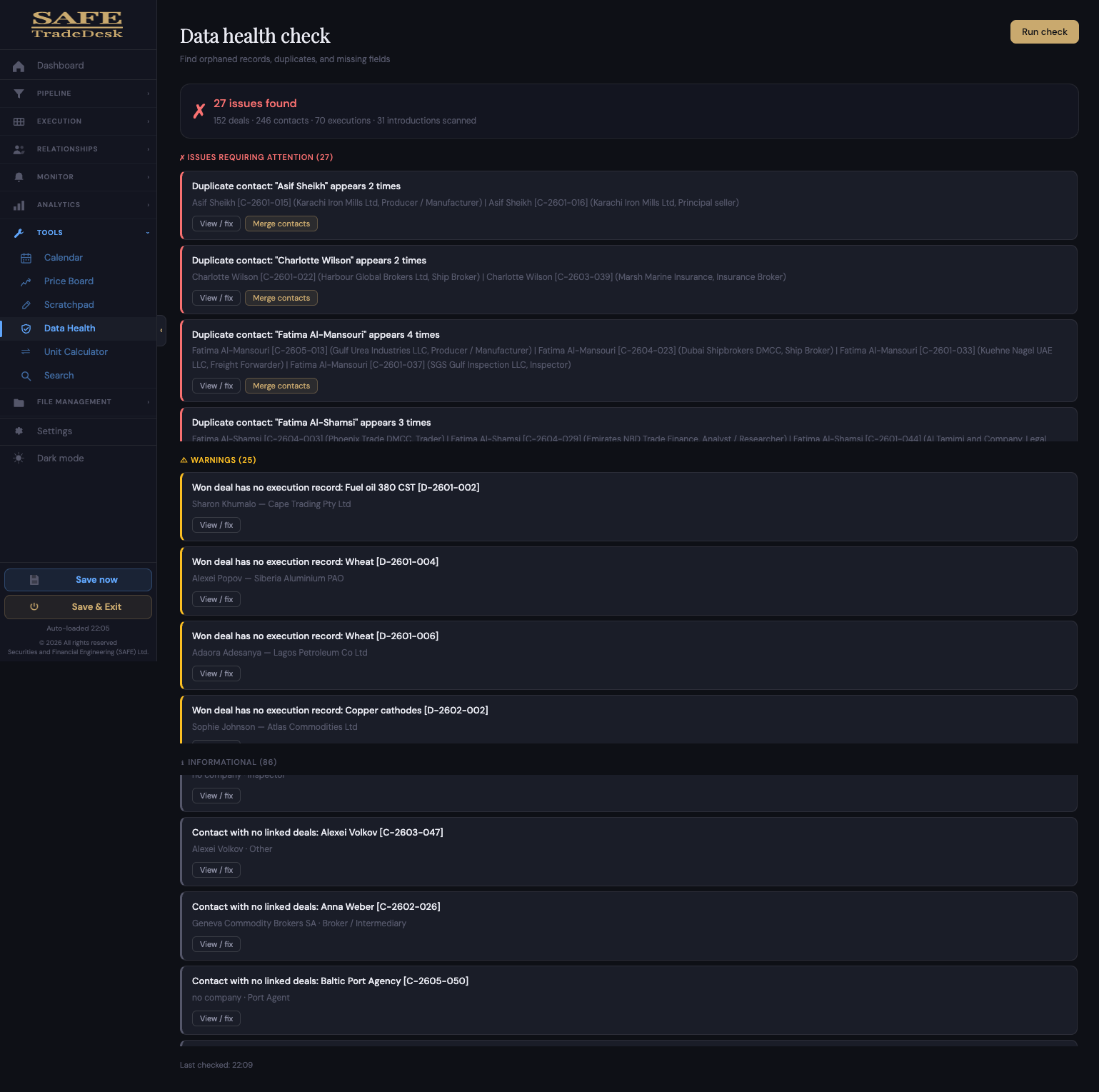
Data Health
Duplicates, orphans, won deals without execution, KYC gaps. A weekly housekeeping pass.
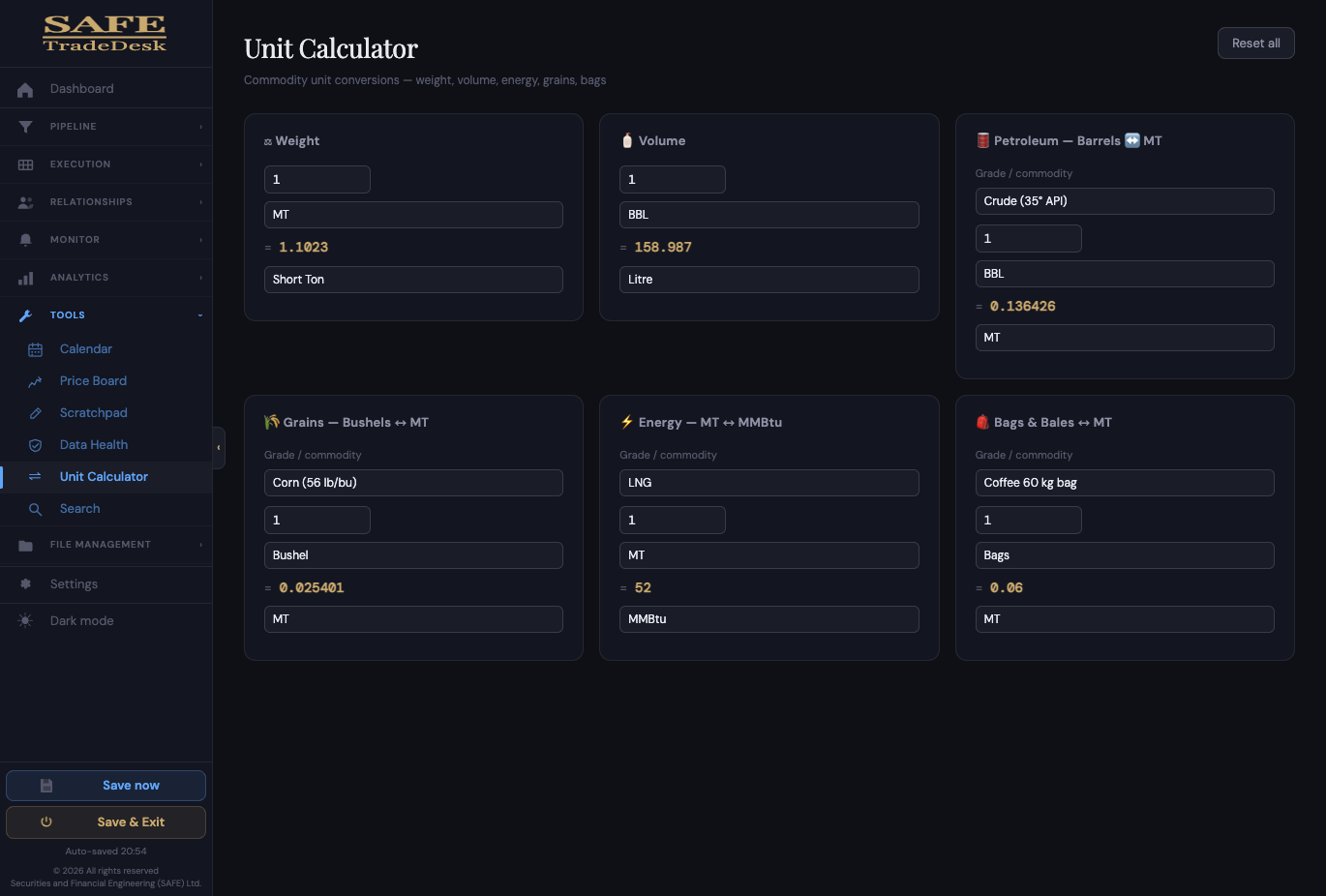
Unit Calculator
Weight · volume · BBL · bushels · MMBtu · bags — always one click from any deal.
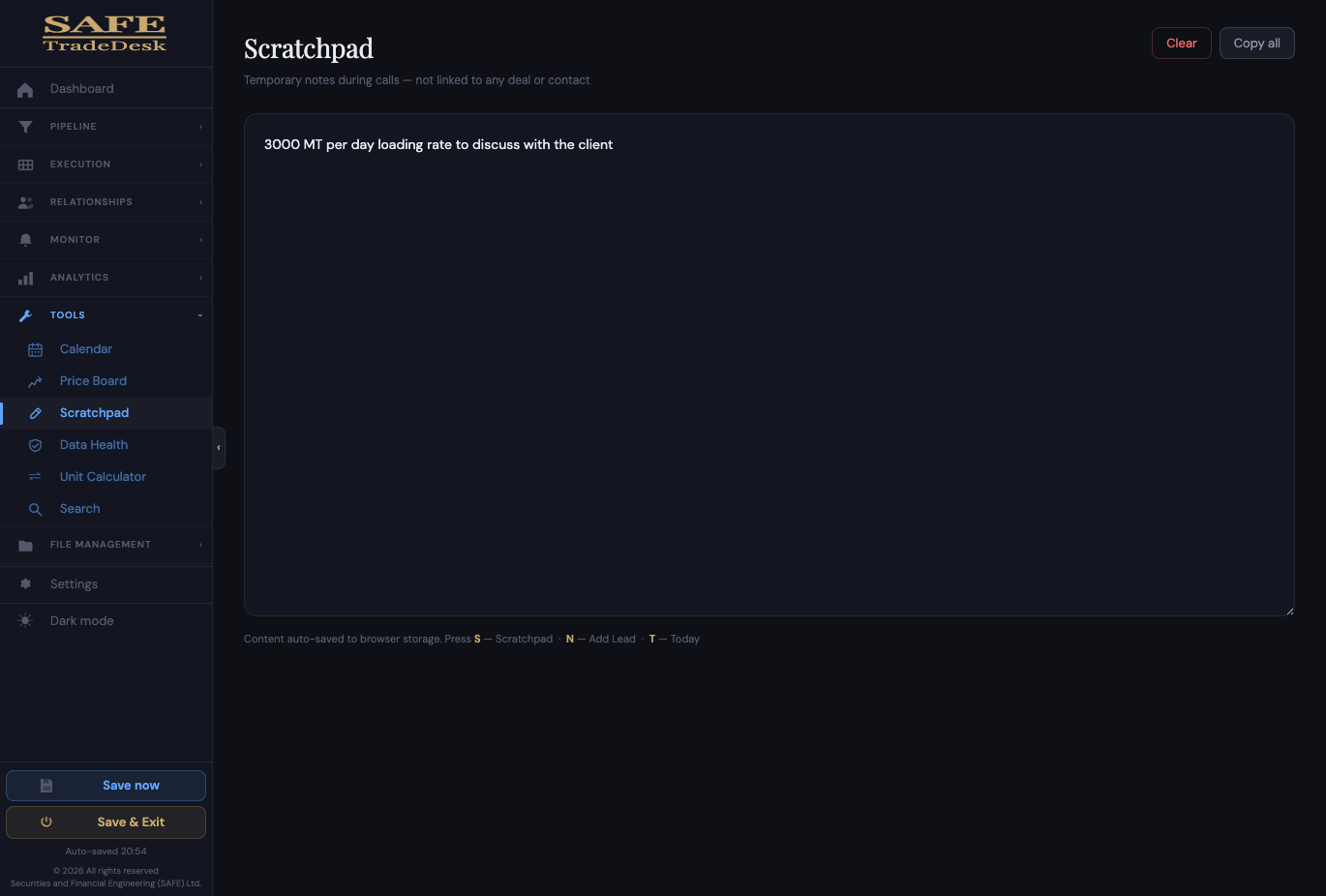
Scratchpad
Persistent scratch surface for numbers and notes that don't belong on a deal yet.
Your data stays in a file you can read in Notepad.
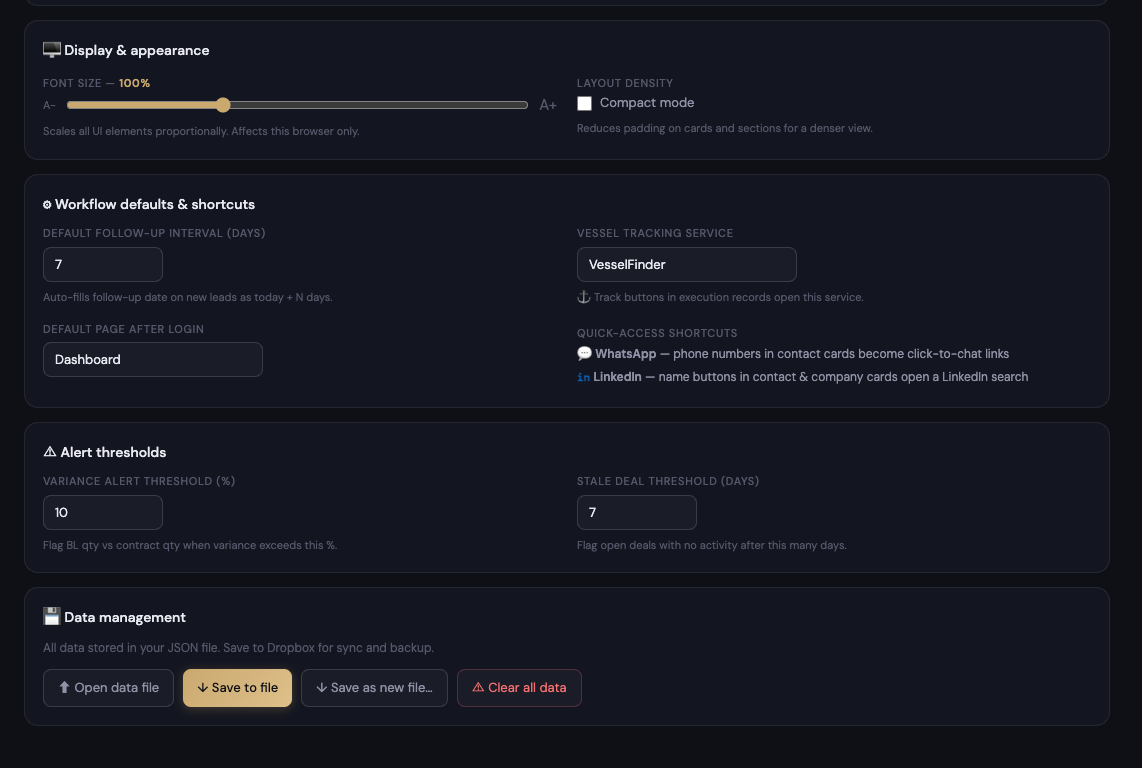
No servers, no database service. One HTML file, one JSON file — saved manually, auto-backed up to five rotating slots, archivable, exportable. If we vanish tomorrow, your data is still readable.
- ⚿Password protectionOptional local password gate on top of OS encryption.
- ⤓Backup slotsFive rotating slots run automatically every save.
- ⎌Year-end archive & purgeSnapshot the year, never touch contacts or intros.
The complete capability map.
Deals, multi-link, matches, probability, follow-ups.
Source allocation, BL qty, vessel snapshots, stages, docs.
Vessel registry, IMO lookup, voyage history, tracker links.
Contacts, companies, KYC, timelines, WhatsApp, LinkedIn.
Protection, renewals, network map, value attribution.
Commission tracker, forecast, ledger, realised income.
Today, calendar, stale deals, balances, overdue.
Fixed vs formula, QP & benchmark mismatch alerts.
Lead parse · daily brief · counterparty & email drafts. BYO API key (Claude, OpenAI).
Reports, forecast, activity, counterparty, intro report.
Price Board, Scratchpad, Data Health, Unit Calculator.
Local JSON, password, backups, archives, FX, CSV export.
Designed for a desk that wants control,
not complexity.
A local-first deal, relationship and execution platform
for active physical commodity operations.